.svg "MCO-Color-logo")



Customer Event | MCO Customer Roadshow Europe 2026 – Registration is now open

The Financial Conduct Authority (FCA) supervises numerous UK financial firms. To do so effectively, firms must submit accurate, complete, and timely data.
Regulatory reporting is not just a formal obligation; it enables the FCA to identify risks, detect misconduct, and determine when to intervene. Incomplete, inaccurate, or delayed reporting may result in regulatory scrutiny, even if no underlying misconduct exists.
Recently, the FCA has increased enforcement, focusing on reporting quality, internal controls, and accountability at both firm and individual levels.
FCA regulatory reporting requires firms to submit data, notifications, and disclosures so the regulator can assess financial stability, risks, and compliance with rules.
The exact requirements vary depending on the firm’s business model. However, most firms are expected to report on areas such as:
For example, advisory firms are required to submit data on adviser qualifications, charging structures, complaints, and competence issues. These reporting obligations allow the FCA to assess whether firms are operating in line with regulatory expectations.
Tip- Do not view reporting as a periodic chore. It reflects how well your data, controls, and processes operate day to day.
FCA reporting plays a central role in how firms are supervised. It provides regulators with a consistent view of how firms operate, where risks may exist, and whether customers are being treated fairly.
Beyond compliance, reporting signals the strength of governance and control. Failures—even without misconduct—can trigger enforcement.
The FCA expects accurate, complete, and consistent reporting. Firms should ensure systems and controls support reliable submissions across all areas.
Firms typically deal with multiple types of FCA reporting, depending on their permissions and activities.
These reports provide visibility into trading activity, financial position, and regulatory metrics. They must be accurate and submitted within the required timelines.
Firms must report customer complaints and conduct-related issues. This helps the FCA monitor how firms handle customer outcomes and identify patterns that may require intervention.
Advisory firms must demonstrate that advisers meet required standards, maintain appropriate qualifications, and operate within defined competence frameworks.
Financial data enables the FCA to assess a firm's stability, liquidity, and risk exposure. Inaccurate reporting in this area can raise concerns about governance and financial resilience.
The Senior Managers and Certification Regime (SMCR) introduced a stronger focus on individual accountability within financial firms.
Under SMCR, firms must report on specific events. These include the appointment of new senior managers, any changes affecting a senior manager’s fitness or propriety, breaches of conduct rules by senior managers (within a defined timeframe), annual reporting of employee conduct breaches, updates to statements of responsibility, and certification of individuals performing regulated roles.
In addition to these defined steps, firms are also required to notify the FCA about any other issue the regulator would reasonably expect to know about. This means firms must assess which events are reportable beyond the explicitly listed requirements.
This creates an additional layer of responsibility. Firms must not only follow defined reporting rules but also exercise judgment in identifying reportable events.
Pro Tip- Map SMCR responsibilities clearly across systems, not just in documents. Accountability becomes difficult to evidence when ownership is unclear at an operational level.
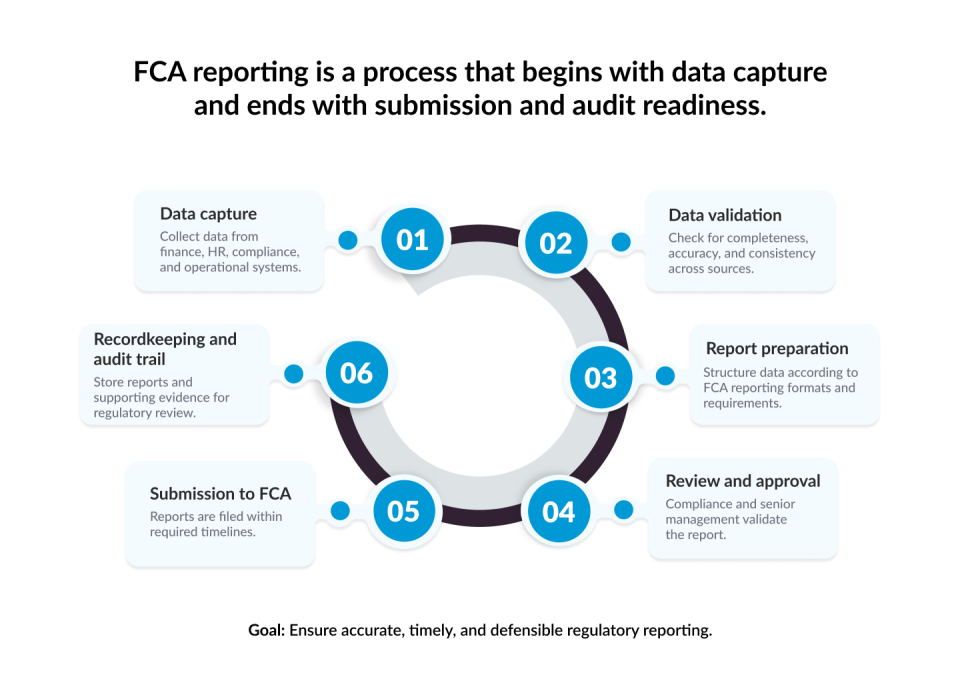
A reliable process requires coordination across systems, teams, and controls, not just preparing submissions.
A typical FCA reporting workflow includes:
Relevant data is gathered from across the business, including finance systems, HR records, compliance tools, and operational platforms.
Data is checked for completeness, accuracy, and consistency. Teams may reconcile sources and resolve discrepancies.
Structured reports are created in accordance with FCA formats and submission requirements.
Reports are reviewed by compliance or senior management to ensure accuracy and appropriateness before submission.
Reports are submitted to the FCA and stored with documentation to ensure a clear audit trail.
Pro Tip- Focus on data quality at the source. Fixing errors during report preparation is significantly harder than preventing them during data capture.
The FCA has consistently taken action against firms that fail to meet reporting obligations. Importantly, enforcement is not limited to cases involving market abuse or misconduct.
Firms may face penalties where:
In past enforcement actions, firms have been fined for failing to maintain adequate controls, failing to detect reporting errors, and submitting inaccurate transaction data over extended periods.
This highlights a key point. Reporting failures is often treated as a control issue rather than an administrative one.
Many firms struggle to meet FCA reporting requirements for similar reasons.
Where controls are inconsistent or poorly integrated, reporting becomes unreliable and difficult to validate.
Manual data collection and record-keeping increase the risk of human error and slow down reporting timelines.
Inaccurate or incomplete data at the source creates problems that are difficult to fix later.
Disconnected systems make it harder to maintain consistency across different reporting areas.
Pro Tip- If reporting depends heavily on spreadsheets and manual reconciliation, the risk of error is already higher than it should be.
Firms can strengthen their reporting processes by focusing on a few core areas.
Ensure policies align with the latest FCA and SMCR expectations, and that reporting obligations are clearly defined.
Implement processes that ensure all required data is captured accurately and consistently across the business.
Employees should understand what needs to be reported, when it needs to be reported, and how to escalate issues.
Continuous monitoring uncovers anomalies and inconsistencies before they lead to reporting failures.
Technology standardizes workflows, improves data visibility, and reduces manual tasks.
Meeting FCA reporting requirements takes proactive effort. Take concrete steps now to assess your firm's data, controls, and oversight, and make improvements to ensure you meet regulatory expectations.
Fragmented or manual processes make consistency harder and increase the risk of reporting errors over time.
Start strengthening your reporting today by integrating reliable controls, ensuring robust governance, and embedding accountability into daily operations. Take action now to reduce risk and meet FCA expectations.