.svg "MCO-Color-logo")



Customer Event | MCO Customer Roadshow Europe 2026 – Registration is now open

Employee conflicts of interest sit at the centre of conduct risk in financial services. They arise in everyday business decisions, in employee relationships, and firms’ commercial structures. Left unchecked, they can expose individuals and firms to regulatory enforcements, reputational harm, and even serious legal repercussions.
Regulators around the world have sharpened their focus around employee conflicts of interest in recent years. The Australian Securities and Investments Commission (ASIC) updated its conflicts management guidance for the first time since 2004, publishing a revised Regulatory Guide 181 (RG 181) in December 2025. The Monetary Authority of Singapore (MAS) updated its guidelines on conflicts for fund management companies the same month. Hong Kong's Securities and Futures Commission (SFC) has made conflicts-of-interest oversight a stated priority in its 2024–2026 strategic plan. In the US, the Securities and Exchange Commission (SEC) and FINRA continue to treat conflicts as a recurring supervisory priority. And in the UK, the Financial Conduct Authority (FCA) is actively consulting on simplifying and strengthening its conflicts-of-interest rules under SYSC 10 of the FCA Handbook.
This article explains what constitutes a conflict of interest in financial services, how the regulatory frameworks in key markets approach conflict management, and what practical steps compliance teams can take to monitor and manage them more effectively to actively reduce their firm’s risk.
A conflict of interest arises when a person or organisation has multiple interests relating to a situation, and serving one of those interests creates a risk of failing to properly serve another. In financial services, these interests are frequently financial in nature. They may relate to investments an employee holds, third-party relationships that generate income, or arrangements that benefit one client at the expense of another.
Interests that give rise to conflicts are not limited to financial ones. Personal, family, professional, business and political interests can each create a conflict, depending on context.
Regulatory bodies around the globe recognise the same underlying problem, but they frame it differently depending on jurisdiction. In Australia, ASIC describes conflicts using three categories: actual, apparent and potential. Singapore’s MAS uses similar framing, referring to actual, potential or perceived conflicts depending on the context, though it applies the terms less consistently. Hong Kong's SFC generally frames the duty around actual or potential conflicts. In the US and UK, the frameworks examine conflicts by type while also setting out how firms must respond. These approaches are discussed below.
The three-category model below is the framing set out most clearly by ASIC. It remains a useful way for compliance teams to think about employee conflicts of interest.
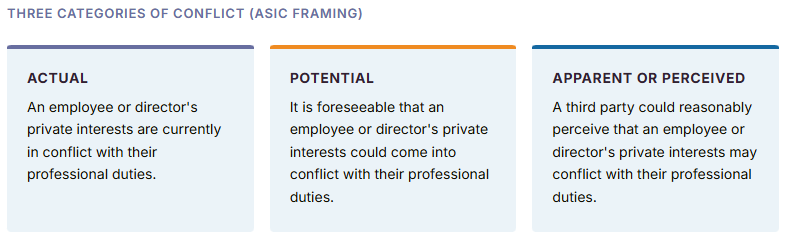
ASIC's updated RG 181 uses the terms actual, apparent and potential. It states that a conflict of interest can arise through “competing financial interests, personal interests, business or related party interests” and “competing loyalties and obligations”. ASIC expects firms to apply a common-sense, objective standard when deciding whether a conflict exists. The regulator asks firms to focus on whether the conflict has a real and reasonable possibility of influencing the judgement or actions of an employee, director or agent in an adverse way.
MAS and the SFC do not apply the three-category model as uniformly as ASIC. MAS guidance refers to actual, potential and perceived conflicts, but the formulation varies by context. Its fund management guidelines, for example, require CEOs and executive directors to mitigate actual or perceived conflicts. In other guidance, MAS uses an actual or potential framing. The terms are not set out together as a single defined framework, and MAS removed the proposed requirement to identify and mitigate perceived conflicts when it finalised its due diligence requirements for corporate finance advisers. The SFC takes a more consistent line, framing the duty in its Codes of Conduct and Fund Manager Code of Conduct as taking all reasonable steps to identify, prevent, manage and monitor actual or potential conflicts of interest. Compliance teams operating across APAC should therefore check the precise wording that applies in each market, rather than assuming a single shared framework.
The SEC and FINRA do not use the actual, apparent and potential taxonomy as their organising framework. The US approach combines two lenses. First, regulators examine conflicts by type. The SEC’s Division of Examinations reviews core areas such as marketing, valuation, trading, portfolio management and custody, and within those it focuses on conflicts arising from specific sources. These include compensation and incentive arrangements, affiliations between investment advisers and broker-dealers, affiliated transactions, fee structures and proprietary product offerings. The SEC’s staff bulletin sets out common sources of conflict by type, with compensation and revenue arrangements among the most prominent.
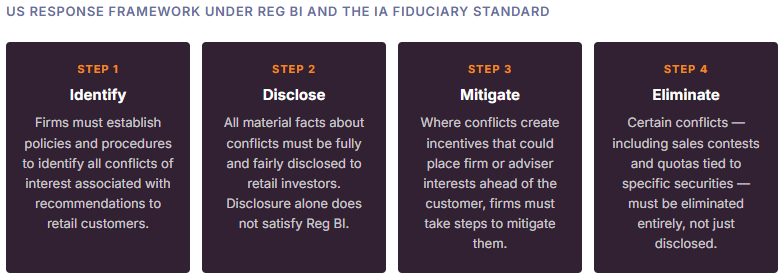
Second, US regulation prescribes what firms must do with a conflict once identified. Under Regulation Best Interest (Reg BI), broker-dealers must identify, disclose, mitigate, or in some cases eliminate conflicts of interest. Investment advisers registered under the Investment Advisers Act of 1940 are held to a fiduciary standard that requires them to eliminate a conflict, or at minimum make full and fair disclosure so that a client can provide informed consent.
The FCA sets out its conflicts of interest obligations primarily through SYSC 10 of the FCA Handbook, which applies to all authorised firms. SYSC 10 is high-level and principles-based, designed to be applied proportionally across the wide range of services that authorised firms provide. The FCA does not impose a fixed actual, apparent and potential taxonomy. It does, however, describe circumstances that give rise to conflicts by type. These include a firm gaining financially at a client's expense, a firm having an interest in the outcome of a service provided to a client, and a firm receiving an inducement from a third party. Firms must take all reasonable steps to identify conflicts that could adversely affect client interests, and manage them through written policies, organisational arrangements, information barriers or disclosure where appropriate.
In December 2025, the FCA published Consultation Paper CP25/36, proposing to rationalise the conflicts of interest rules in SYSC 10 as part of a broader programme to simplify the FCA Handbook. The FCA's stated intention is to make the rules more concise and accessible without changing the substantive obligations. The consultation closed in February 2026 and the FCA is expected to publish final rules in due course.
Every regulator discussed here identifies conflicts by type and expects firms to follow a structured response of identification, management, disclosure, and reasonable efforts to mitigate risk. What differs is the emphasis, the formality of the categories and the precise terms each regulator uses.
|
Jurisdiction |
APAC (ASIC, MAS, SFC) |
United States (SEC, FINRA) |
United Kingdom (FCA) |
|
Primary framework |
ASIC classifies by type: actual, apparent and potential. MAS uses similar framing including perceived conflicts, though less consistently. The SFC frames the duty around actual or potential conflicts |
Classify by response: identify, disclose, mitigate, eliminate |
Identify and manage — proportionate to the nature of services |
|
Key obligation |
Identify, assess, document and manage conflicts; ASIC requires adequate arrangements, MAS and the SFC require all reasonable steps |
Broker-dealers: Reg BI. Investment advisers: fiduciary duty under Advisers Act |
SYSC 10: take all reasonable steps to identify and manage conflicts |
|
Disclosure |
Required where conflicts cannot be prevented; must be specific and meaningful |
Required for all material conflicts; must be full and fair. Disclosure alone insufficient under Reg BI |
Required where management arrangements cannot sufficiently protect client interests |
|
Documentation |
Conflict assessments must be documented and available to regulator on request (MAS); adequate arrangements must be demonstrable (ASIC) |
Written policies and procedures required under Reg BI; must be maintained and enforced |
Written conflicts policy required; firms must maintain an up-to-date record of identified conflicts |
Financial services firms carry an elevated exposure to conflicts of interest. The commercial relationships, compensation structures and information flows inherent to the industry create conditions where private and professional interests can overlap.
The following areas carry particular risk across financial services firms globally.
|
Area |
Description of conflict risk |
|
Personal account trading |
Employees trading in securities or assets they have access to through their professional role, or trading ahead of client orders |
|
Gifts and entertainment |
Acceptance of gifts, hospitality or entertainment from third parties that could influence professional judgement or decisions |
|
Outside business activities |
Employees holding roles, directorships or financial interests in entities that compete with or do business with the firm |
|
Close personal relationships |
Personal relationships between employees that affect the objectivity of decisions over pay, promotion or risk oversight |
|
MNPI and insider information |
Employees with access to material non-public information making decisions or disclosures that benefit themselves or others |
|
Compensation and remuneration |
Incentive structures that reward employees for recommending products or services that serve the firm's interests over the client's |
|
Research and underwriting |
Investment banking research divisions facing pressure to align analysis with underwriting relationships or commercial interests |
|
Related-party transactions |
Fund managers or advisers directing business to related entities without adequate disclosure or controls |
|
Cross trades |
Trades between funds or clients managed by the same firm without independent oversight or proper controls |
The above is not an exhaustive list of risk areas. The MAS fund management guidelines, updated in December 2024, expanded the examples of scenarios where conflicts can arise and made clear that the list is not prescriptive. Firms are expected to identify conflicts specific to their own business model and structure. The SEC and FINRA have similarly noted that all investment advisers and broker-dealers have at least some conflicts, with compensation arrangements among the most common sources.
Firms should assume that conflicts of interest will arise at one time or another. The objective for compliance teams is not to prevent all possible conflicts but rather to become equipped with systems and processes that identify conflicts reliably, assess them systematically, and respond to them proportionately.
The following three steps form the basis of an effective conflicts management framework, and are broadly consistent with the expectations of regulators across APAC, the US and the UK.
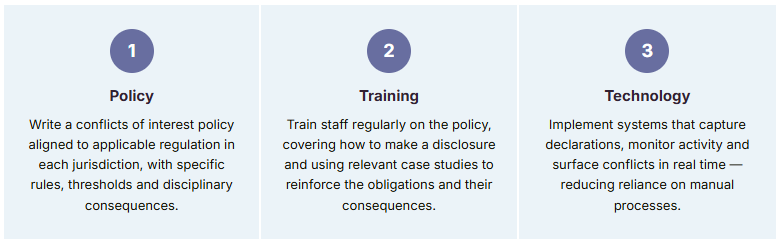
Step 1. Review Your Employee Conflicts of Interest Policy
The policy should be specific to the firm's business model and the jurisdictions in which it operates. It should set out the types of activity and relationship that can give rise to a conflict, the process employees must follow to declare one, and the consequences of failing to do so. Where thresholds are relevant, for example, in relation to gifts and entertainment, the policy should state them clearly. Generalities create ambiguity and make consistent enforcement difficult.
Under MAS's updated fund management guidelines, conflict management policies must be independently reviewed and approved at an appropriate level of authority. Under ASIC's RG 181, firms must be able to demonstrate that their arrangements are adequate, which means the policy must link to actual controls, not simply state principles. In the US, Reg BI requires written policies and procedures that are not only maintained but actively enforced. In the UK, SYSC 10 requires firms to maintain an up-to-date conflicts policy and a record of identified conflicts.
Step 2. Train and educate staff consistently
A policy that employees are not aware of, or do not understand, provides limited risk mitigation. Regular training that covers the firm’s conflict disclosure process, the types of situations that require a declaration, and the firm's expectations around conduct helps build the culture that regulators look for. Refreshing training with current case studies, drawn from regulatory findings in relevant jurisdictions, also gives practical relevance to obligations for staff at all levels.
Step 3: Implement Technology to Monitor Conflicts at Scale
For compliance teams operating across multiple markets and large employee populations, manual monitoring of conflicts creates significant gaps. The volume of activity that can generate a conflict, and the speed at which situations can develop, means that a manual approach will regularly fall short of regulatory expectations.
Technology enables compliance teams to capture conflict declarations, monitor personal trading and outside business activities, track gifts and entertainment, and run conflict checks against employee activity in real time. It also produces the audit trail that regulators in APAC, the US and the UK each require when they assess the adequacy of a firm’s compliance programme.
Regulatory technology solutions such as MCO (MyComplianceOffice) provide a centralised system for managing compliance obligations across multiple jurisdictions and regulators. MCO’s Know Your Employee Compliance Suite provides an integrated solution for monitoring, identifying, and addressing conflicts of interest and code of conduct issues.
MCO helps financial firms more effectively manage:
As a complete compliance management suite, MCO gives compliance teams a single view of employee activity, regulatory obligations, licensing requirements and status, and much more. As a result, compliance teams spend less time managing disparate compliance processes and add reclaim capacity for strategic priorities.
Are you ready to help your firm meet evolving regulatory expectations? See the MCO (MyComplianceOffice) complete compliance suite in action now.
Also see our white paper Gifts, Entertainment, and Hospitality: from Small Perks to Serious Risk and in-depth eBook Mitigating Employee Conflicts of Interest for further insights around reducing your firm’s risk.