The Australian Securities and Investments Commission (ASIC) has set a 30 June 2026 deadline which demands immediate attention by financial services firms operating in Australia with exposure to digital assets.
Providers of financial services involving digital asset financial products must apply for an Australian Financial Services (AFS) licence before 30 June 2026. Where relevant, they must notify ASIC of their intention to apply for a Market Licence or Clearing and Settlement facility licence by the same date. Firms that miss the deadline may expose themselves to serious penalties under Australian financial services law.
For compliance professionals seeking broader context on how Australia’s digital assets regulatory landscape has evolved to reach this point, MCO's article Australia: Defining the Next Phase of Crypto Regulation provides a useful overview.
“Unlicensed conduct carries serious civil and criminal penalties under law, including significant fines that could reach up to 10% of annual turnover.” — ASIC, May 2026
Key Highlights
- ASIC’s digital asset no-action position expires 30 June 2026.
- AFS licence applications must be lodged before that date.
- Penalties for non-compliance may reach up to 10% of a firm’s annual turnover.
- The 30 June deadline precedes the DAF Act’s April 2027 commencement.
- AUSTRAC's expanded AML/CTF obligations begin in July 2026.
What Is the 30 June 2026 Deadline?
Since October 2025, ASIC has operated a class no-action position attached to Information Sheet 225 (INFO 225), Digital assets: Financial products and services. The no-action letter afforded firms dealing with digital assets within its scope a degree of regulatory flexibility. Firms could continue operations without facing immediate enforcement action while they worked toward full compliance. That flexibility expires on 30 June 2026.
After that date, any firm providing financial services in relation to digital asset financial products must have lodged an AFS licence application. Where a business operates a trading venue or clearing and settlement infrastructure, it must have notified ASIC in writing of its intention to apply for the relevant Market Licence or Clearing and Settlement (CS) facility licence. Firms failing to take either of these steps lose the protection of the no-action position and face enforcement risk under the Corporations Act 2001 (Cth).
What Is a Digital Asset Within the Regulatory Scope?
ASIC updated INFO 225 in late 2025 to clarify the scope of digital assets falling within the existing definition of a financial product under the Corporations Act. The guidance covers a broad range of arrangements, including stablecoins, wrapped tokens, tokenised securities, and digital asset wallets. Note that ASIC has granted specific class relief to distributors of eligible stablecoins and wrapped tokens via the ASIC Corporations (Stablecoin and Wrapped Token Relief) Instrument 2025/867. Providers uncertain about their own classification should obtain written legal advice before 30 June.
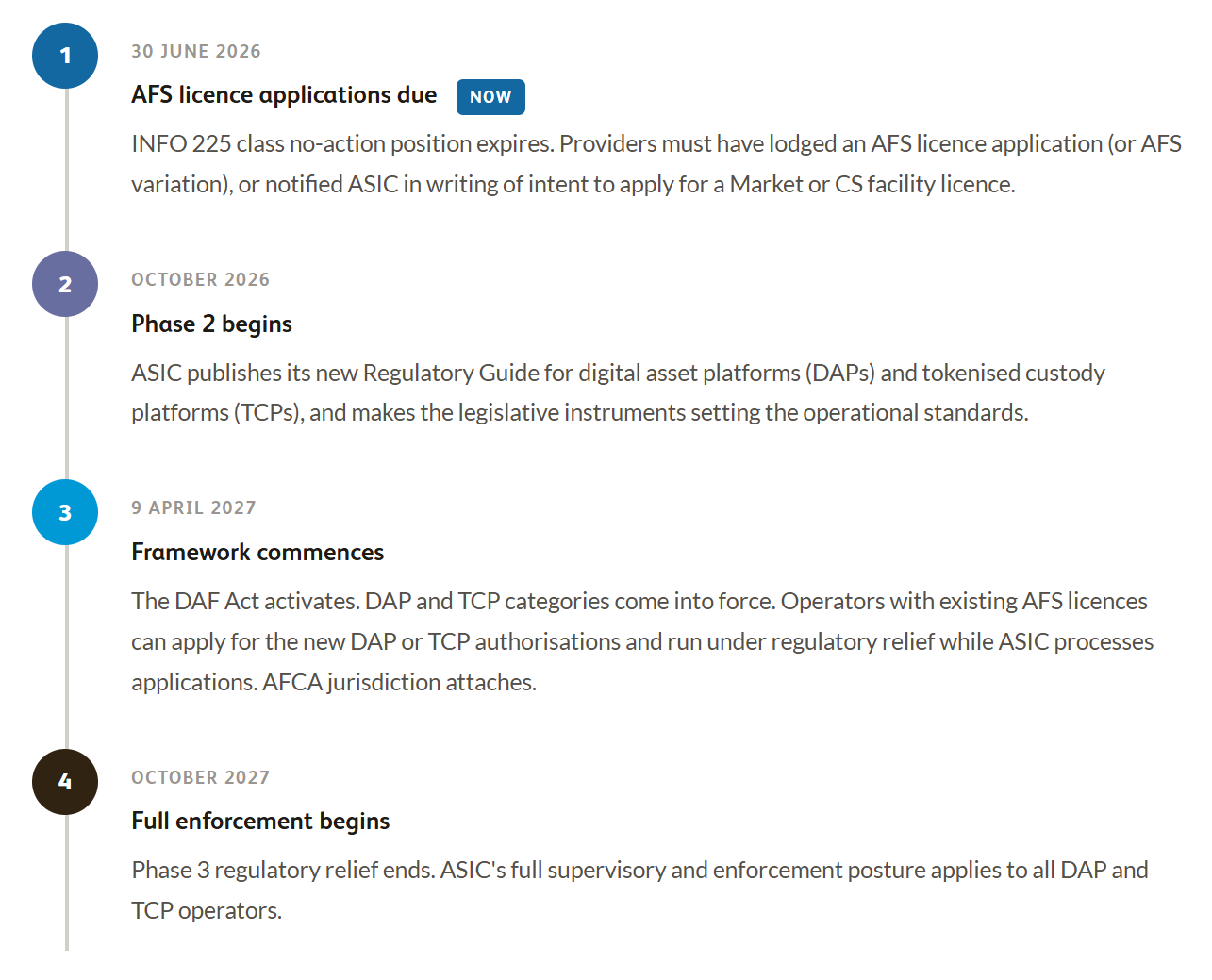
The 30 June 2026 date is the only point in ASIC’s roadmap that determines whether a business is inside or outside the regulatory perimeter at all. Phases 2 and 3 produce new guidance and create new authorisation categories. However, they assume that a firm already holds an AFS licence. Missing the 30 June deadline means there is no licence for the later Framework steps to attach to.
To Which Firms Does the 30 June Deadline Apply?
The deadline applies to anyone providing financial services in relation to digital asset financial products. ASIC’s language is deliberately broad. Spot exchanges, custodians, brokers, asset managers, lending platforms, and any firm offering financial-product-style services in connection with digital assets may fall within the scope.
The critical question for many firms is whether the underlying digital asset, or the services around it, falls within the existing definition of a financial product under the Corporations Act. Where it does, the provider must be inside the licensing regime by 30 June. The new Digital Asset Platforms (DAP) and Tokenised Custody Platforms (TCP) categories created by the DAF Act do not arrive until April 2027. The 30 June deadline is governed by the existing AFS licensing regime, not by the new categories.
Wholesale-Only Providers Are Not Exempt
The wholesale/retail distinction affects certain licence conditions and consumer protection obligations, but not the question of whether a licence is required at all. Wholesale-only digital asset service providers must still hold an AFS licence and must still apply by 30 June 2026.
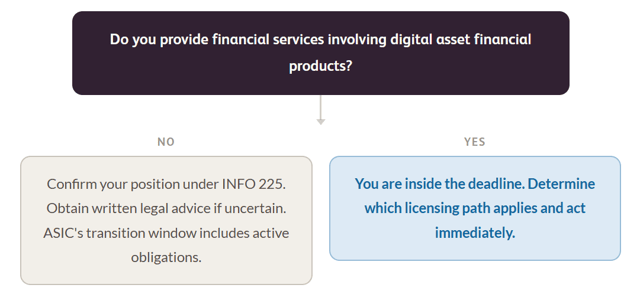
Which Licensing Path Applies?
There are four actions a business may need to take before 30 June 2026, depending on its current position.
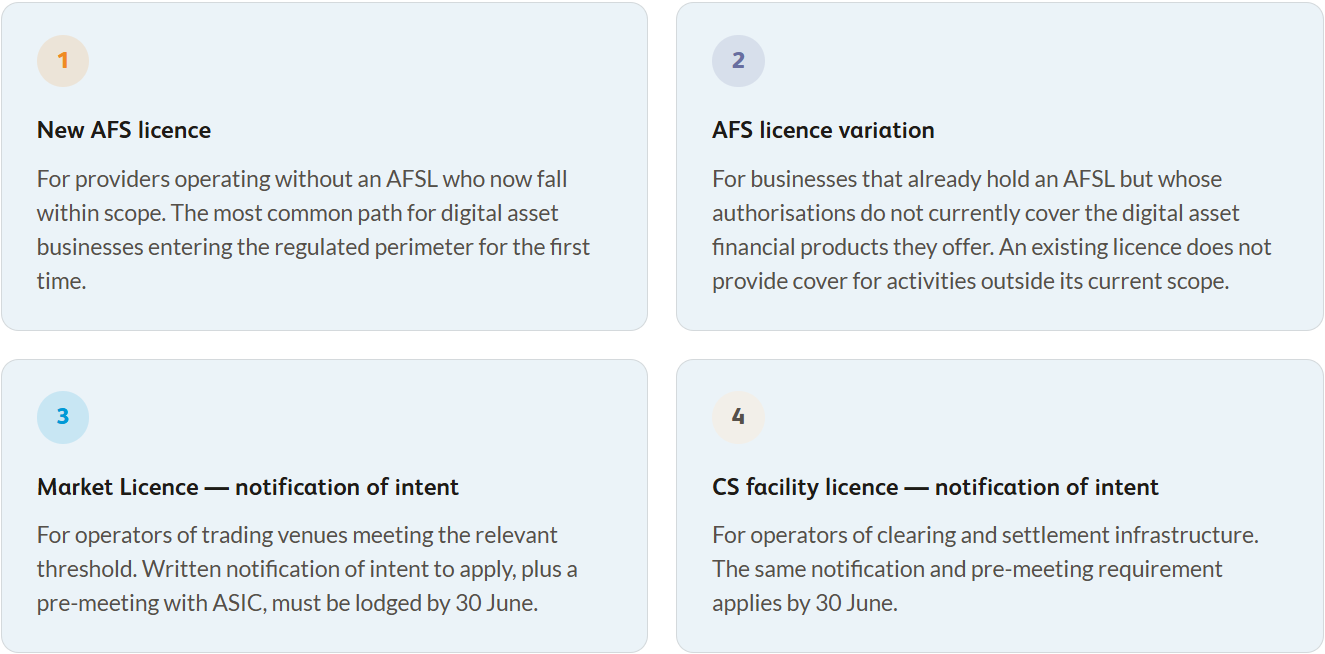
Paths 1 and 2 cover the great majority of digital asset firms. Paths 3 and 4 apply to a smaller set of trading venues and infrastructure operators. Firms uncertain about which path applies should engage legal counsel immediately.
What Happens if Financial Services Firms Miss the Deadline?
The commercial consequences can compound quickly. Firms that miss the deadline may be exposed to civil and criminal penalties under financial services law. ASIC states the upper limit for fines under financial services law for unlicensed conduct as 10% of annual turnover. The penalty range extends to court-ordered disgorgement, banning orders against responsible managers, and, in serious cases, criminal prosecution.
Providers outside a current AFS authorisation, with no application or notification on file, are exposed to the full enforcement posture of the Corporations Act 2001 (Cth) and the Australian Securities and Investments Commission Act 2001 (Cth).
For financial advisers, the deadline creates a distinct due diligence obligation. After 30 June 2026, adviser due diligence on digital asset platforms should reasonably extend to verifying that any platform recommended has either lodged an AFS licence application or already holds an AFSL with authorisations covering its digital asset services. Platforms that miss the deadline move outside the perimeter that advisers should reasonably recommend.
What Should Financial Firms Do Now?
Determine your licensing path. Identify whether you need a new AFS licence, an AFS variation, or a notification of intent for a Market or CS facility licence. This is the first conversation to have with legal counsel.
Engage counsel and a licence consultant immediately. A substantive AFS licence application takes time to prepare. ASIC will assess the substance of what you lodge. An incomplete application is not a placeholder, and a notification of intent is not an application.
Identify your responsible managers. Every AFSL nominates responsible managers against the authorisations sought. For digital asset financial products, ASIC will assess relevant experience and competence in those specific products and services.
Map your services to authorisations. AFSL conditions are specific. A spot-only execution venue requires a different authorisation set from a custody platform offering both execution and asset-holding. Your firm must provide complete mapping at lodgement.
Review your financial resources position. The new DAP and TCP financial requirements arrive with Phase 2 guidance in October 2026. Until then, existing requirements under Regulatory Guide 166 apply. Providers should be within those thresholds before lodging.
Additionally, if you need to clarify classification questions, engage with ASIC directly as a demonstrated sign of proactive compliance.
Plan Ahead for the Next Step
Lodgement of an AFS licence application by 30 June is the first step. From 9 April 2027, businesses that have moved into the AFS regime will need to lodge a further variation to add the new DAP or TCP authorisations created by the DAF Act.
How Compliance Teams Can Manage AFS Licensing Obligations at Scale
The 30 June 2026 deadline brings a compliance programme management challenge. Compliance functions must determine licensing scope, document responsible managers, map services to authorisations, maintain financial resources evidence, and track the next phase of the DAF Act rollout. All of this sits alongside existing obligations across AML/CTF, conduct, and employee oversight.
Managing that workload can become manually intensive and time-consuming. Australia’s digital assets framework includes obligations across ASIC licensing and AUSTRAC’s expanded AML/CTF regime. Compliance teams need to track obligations across both regimes without relying on fragmented spreadsheets and siloed records.
Regulatory technology solutions such as MCO (MyComplianceOffice) provide a centralised system for managing compliance obligations across multiple jurisdictions and regulators. As a complete compliance management suite, MCO also gives compliance teams a single view of employee activity, regulatory obligations, licensing requirements and status, and much more as they evolve through each phase of ASIC’s implementation roadmap.
For firms whose employees hold or trade digital assets, MCO's Digital Asset Personal Trading solution provides a purpose-built workflow for managing employee personal trading in digital assets and cryptocurrency. This is a particularly relevant capability as AFSL obligations bring greater scrutiny to conflicts of interest and employee conduct. With the Digital Asset Personal Trading solution, compliance teams can:
- Track digital asset holdings across employees
- Pre-clear trades before execution
- Recognise wallets natively within the platform
- Maintain an up-to-date asset list
- Integrate with major exchanges and wallets
- Generate detailed, audit-ready reports
- Establish restriction and exemption lists
- Run conflict checks against employee activity using configurable, rules-based logic
MCO's broader Know Your Employee Compliance Suite provides an integrated solution for monitoring, identifying, and addressing conflicts of interest and code of conduct issues. These obligations do not pause while a firm works through its AFS licensing requirements. The outcome is less time spent managing disparate compliance processes and more capacity for the substantive risk oversight that Australia’s evolving framework now demands.
Are you ready to help your firm meet evolving regulatory expectations? See the MCO (MyComplianceOffice) complete compliance suite in action now.
Also, see our in-depth crypto regulation compliance article which includes the latest updates across Singapore, Australia, the United States, United Kingdom, and more.
.svg "MCO-Color-logo")